This is the story as Henry wrote it for our old site, lightly edited for spelling. The rebuild took the better part of a year and a half; Capri went back in the water after nine months of it. The short version is on the About page — this is the whole thing.
Hi, I’m Henry, a 20-year-old who’s spent the last year and a half rebuilding Capri with my dad. What started as a half-sunken wreck turned into the boat you see on the harbour today. This wasn’t just about fixing a boat — it was about perseverance, learning new skills, and growing Sydney Charter Boat Hire from scratch. Capri’s story is all about dedication, creativity, and the thrill of seeing a dream come to life on Sydney Harbour.
What we started with
The Capri was in really bad shape — half of it had sunk, and we had fished it out a few years back, but the damage lingered. The hull had multiple holes, the deck and furniture were ruined, and the motor was corroded beyond repair. Our previous experience refurbishing the boat gave us confidence that we could bring it back to life.
We stripped the Capri down to the frame, discovering barnacles completely covering the hull. After trying various tools, I realised the most effective way to remove them was with an angle grinder fitted with a wire brush. It worked well, but the battery life meant I could only remove sections at a time, which was okay since I was still recovering from mental health issues. “You have the same charge as the battery,” my father often joked.
You have the same charge as the battery.
Holes, welds and Jotamastic 90
Once the barnacles were cleared, we found large holes in the aluminium hull. Unable to weld it ourselves due to our inexperience, we hired a professional welder who returned the boat stronger than ever. The next phase involved painting the vessel with Jotamastic 90. We painted the tri-hull meticulously, applying multiple layers and using a Bunnings paint rolling kit for protection. Unfortunately, my gown wasn’t sealed, allowing paint to seep through and ruin my favourite shoes.
After the paint dried, we sourced marine-grade planks for the deck, lacquering them with wood oil. We painted the deck with Jotamastic 90 as well, often redoing sections due to falling leaves. We then refurbished the railings and metal furnishings, spray-painting them gloss white.
A couch, a trampoline and a sound system
Next, we reordered aluminium sheets to replace the rusted ones and restructured the layout, removing the driver’s seat to make room for a long couch at the back, adding comfort and space. My dad suggested adding a trampoline to the front, similar to those on catamarans. We tightened the frame and attached the trampoline, making sure it looked good and was functional.
We then purchased a high-quality sound system, the Fusion Signature series, known for its durability and sound clarity. Wiring the system was daunting; we made mistakes, like melting a wire and scorching the newly upholstered seats. Eventually, we connected everything to a switchboard, making the sound and lighting functional.
The motor and the maiden voyage
As for the motor, we missed the Christmas sale and had to buy a Yamaha 60 HP at full price. It was perfect — powerful yet fuel-efficient and quiet. We had it fitted at Sea Sea Marine.
After almost nine months of hard work, the moment finally arrived to put the Capri in the water. Its maiden voyage was smooth, though the canopy flapped in the wind. We secured it with extra ropes, resolving the issue.
After the water
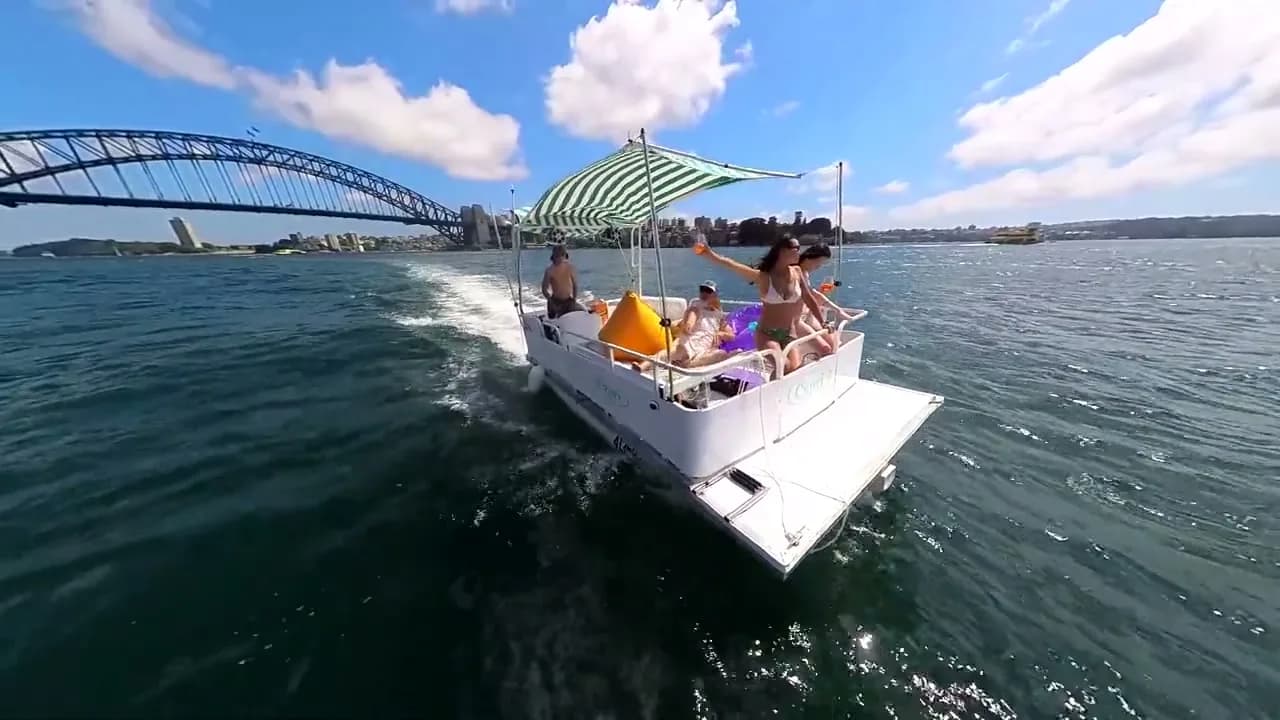
Thrilled with our hard work, we filmed a promotional video with friends to showcase the Capri on Sydney Harbour. With the boat ready, I turned my focus to rebuilding our website, optimising it for visibility, and gathering Google reviews to attract customers.
Completing my Coxswain licence and taking friends out on the harbour felt rewarding — a moment to reflect on the road from a half-sunken wreck to a vibrant, operational vessel. Rebuilding Capri taught me to appreciate the craftsmanship behind any project, and to understand the effort, challenges and collaboration required to turn an idea into a real product.
Since then
Capri has been on the harbour ever since — eight seats, a striped canopy, a trampoline where the bow rail used to be. The people, the wharf and the boat as she is today are on the About page, and the rebuild steps are laid out as a timeline there. If you want to see what nine months of weekends turned into, the gallery is the place.